
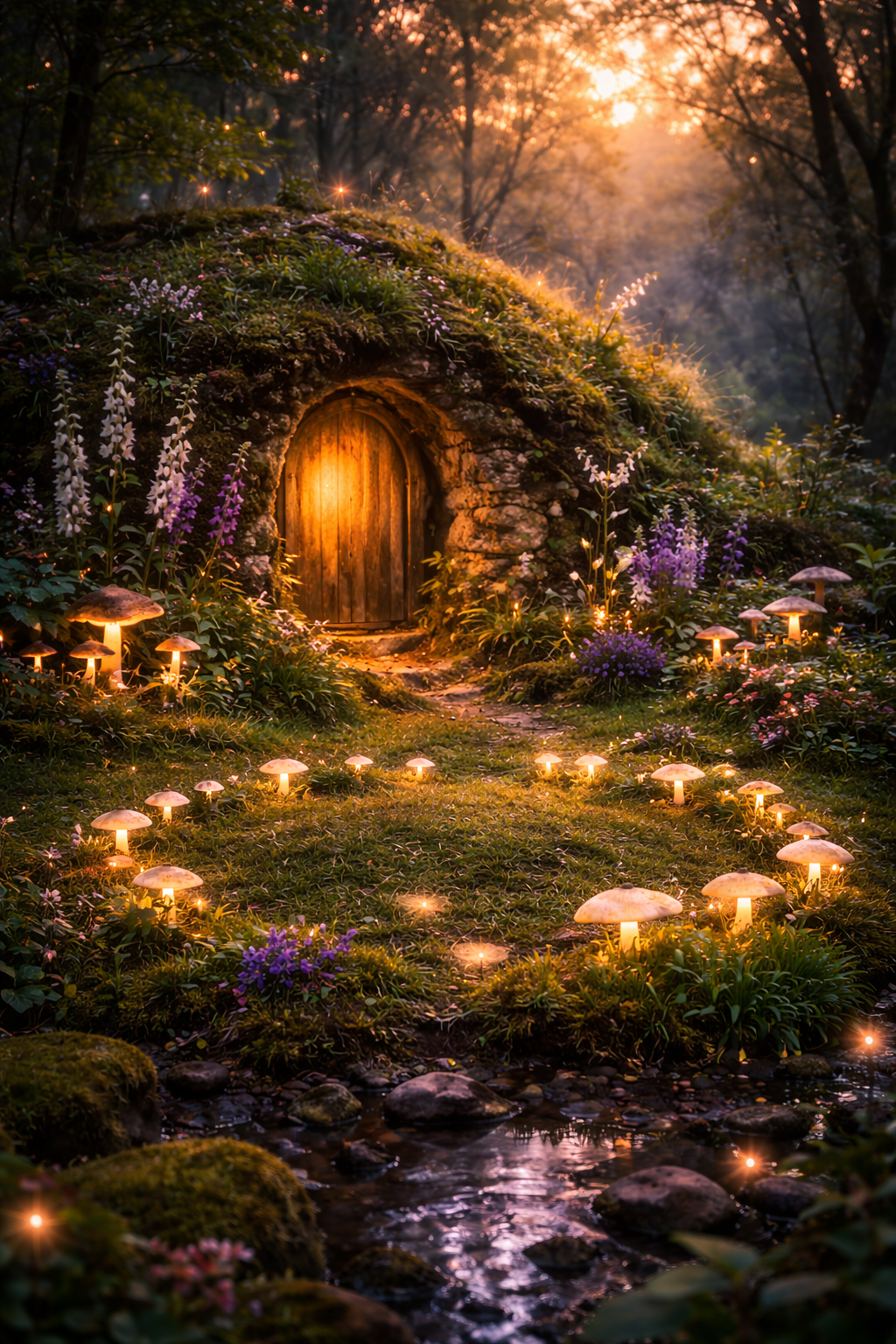
The Fae: Remembering the People of the Sidhe
Across ancient hills and earthen mounds, stories whisper of the Fae — the People of the Sidhe — guardians of liminal spaces where the veil grows thin. Neither benevolent nor malevolent, but powerful and bound to their own laws, they are remembered in folklore as divine beings who retreated beneath the land, dwelling in sacred mounds, fairy rings, and twilight thresholds. This reflection explores who they are, when they appear, the ancient warnings surrounding them, and the deeper wisdom they carry for those willing to walk gently between worlds.
There exists a place just beyond ordinary sight — not hidden, but unseen until we soften enough to perceive it.
Across ancient landscapes, where hills roll like quiet promises and earth mounds interrupt fields, there are whispers of a presence older than the stories we tell. Here, and beneath here, the veil between worlds thins — not just at Samhain or dusk — but wherever the earth remembers.
In Celtic lore and beyond, these beings are known not as the playful fairies of modern imagination, but as the Fae, the Aos Sí, the People of the Sidhe — a powerful, ancient race that stands at the threshold of this world and the Otherworld.
Who Are the Fae?
The word “Aos Sí” comes from old Gaelic meaning “folk of the mounds” or “people of the Sidhe”: sacred earthen hills and burial barrows believed to be portals to the Otherworld.
These beings are not tiny sprites with wings, nor whimsical denizens of children’s tales. In the old traditions, they are often described as beautiful, powerful, and mysterious, neither wholly good nor evil but subject to their own laws, values, and rhythms — mirroring nature itself.
Some tellings connect them to the Tuatha Dé Danann, the mythic divine race of Irish lore. After their defeat by the Milesians, these ancient beings retreated into the earth, becoming the guardians and inhabitants of the hidden realms beneath hills, fort mounds, and sacred groves.
The Fae live both within and beneath the landscape — in ancient barrows, beneath lone hawthorn trees called fairy trees, beside sacred water, and in places where the veil feels thin.
Why the Fae Exist
In many traditions, the existence of the Fae is not an oddity but an embodiment of realities our ancestors felt deeply:
They are memory keepers, bridging this world and the Otherworld, holding the wisdom of land, lineage, and language older than recorded time.
They are mirrors, holding up what we do not see in ourselves.
They are guardians, habiting places that are charged with ancestral power and liminal energy — crossroads, twilight, seasonal thresholds.
They are teachers of consequence, reminding us that unseen life responds to respect and care.
The Fae are not stories meant to entertain — they are ecosystems of meaning, connecting human life to deeper rhythms of nature and spirit.
Where They Appear (and When)
Fae presence is most often associated with liminal spaces and times:
Earthen mounds, stone circles, ancient ruins, and raths
Fairy rings of mushrooms that form natural circles in the grass
Forest clearings and lone hawthorn trees
Dawn and dusk, when light and dark touch
Seasonal thresholds like Samhain, Beltane, the solstices, and equinoxes
In Irish tradition, particular nights — such as Samhain — were believed to diminish the boundary between worlds, allowing the Fae to move more freely among us.
In folklore, fairy rings — natural circles of mushrooms — are often described as places where the fair folk have danced, and stepping into one uninvited might lead a human into the Otherworld.
Ancient Warnings and Sacred Etiquette
The old stories are not cautionary tales for fear’s sake — they are guides for harmonious co-existence:
Never Accept Food or Drink
In many traditions, accepting food or drink from the Fae binds you to their realm, where time flows differently and return is uncertain. It is not disrespect to refuse — it is self-preservation learned across generations.
Never Step Into a Fairy Ring
Fairy rings are not just beautiful patterns — they are spaces charged with Otherworldly presence. Step inside without invitation, and old lore says you may be drawn into the unseen world or wander endlessly without direction.
Do Not Disturb Their Mounds
Ancient burial mounds and raths are considered entrances to the Otherworld. Disturbing them in folklore was believed to invite misfortune or the wrath of the Fae.
Wander With Respect at Liminal Times
Dusk, dawn, and seasonal thresholds are moments when the veil thins. Our ancestors honored these hours with ritual, respect, and careful intention, rather than aimless wandering.
The Fae as Ancestral Wisdom
Above all, the Fae embody what it means to belong to the land and to recognize that reality is not only what can be measured. They remind us:
The world is lived in layers, not just surfaces
Nature holds memory
Boundaries are sacred
Respect is reciprocal
They are not simple spirits to be controlled or summoned. They are rhythms, presences, and energies that intertwine with human life — often seen only when we slow down, listen deeply, and remember that the world is alive with more than what meets the eye.
A Closing Reflection
The next time you find yourself drawn to an old hill, a lone tree at twilight, or a circle of mushrooms glowing in the grass, ask yourself:
What part of your own unseen world is asking to be acknowledged?
And then, listen.